Take the next step
Be part of the future of health research
Whether you're a researcher or participant, Alethios makes health research frictionless and comprehensive.

Sleep is one of the most commonly studied and clinically relevant behavioral health domains. It plays a central role in physical recovery, metabolic regulation, cognitive performance, mental health, and overall quality of life. In decentralized and real‑world studies, wearable‑derived sleep metrics offer a scalable way to measure sleep patterns longitudinally, outside of the clinic, with minimal participant burden.
Sleep is one of the most commonly studied and clinically relevant behavioral health domains. It plays a central role in physical recovery, metabolic regulation, cognitive performance, mental health, and overall quality of life. In decentralized and real‑world studies, wearable‑derived sleep metrics offer a scalable way to measure sleep patterns longitudinally, outside of the clinic, with minimal participant burden.
This post explains why sleep metrics are frequently included in health research, when they are appropriate, how they can be configured in a decentralized study using Alethios, and what data researchers receive once a study is live.
Sleep quality and duration are associated with a wide range of health outcomes, including cardiometabolic risk, immune function, cognitive performance, pain sensitivity, and mood (Buysse, 2014; Walker, 2017). Changes in sleep often precede or accompany changes in other clinical or functional outcomes, making sleep a valuable early signal in many intervention studies.
Wearable‑derived sleep data enables continuous, longitudinal measurement in real‑world settings, complementing both in‑clinic assessments and patient‑reported outcomes. While consumer wearables do not replace polysomnography, multiple validation studies have shown reasonable agreement for sleep duration and timing, and improving performance for sleep staging under certain conditions (de Zambotti et al., 2019).
Sleep metrics should be understood as digital functional endpoints. Their interpretability increases substantially when paired with validated questionnaires, symptom tracking, or physiological measures.
Sleep metrics are commonly used in studies focused on:
They are less appropriate as primary endpoints when sleep is not expected to change over the intervention window, or when participants have highly irregular sleep schedules that are not accounted for analytically.
Alethios supports wearable‑derived sleep metrics from the following personal device ecosystems:
Sleep metrics are standardized for use within Alethios. Participants connect their devices during onboarding, after which sleep data is collected passively according to the study schedule.
Configuration takes place during the Build phase of the Study Planner.
Step 1: Navigate to Build → Add Digital Endpoint
From the Build section of your study, select Add Digital Endpoint to begin configuring wearable‑derived data collection.
Step 2: Select Digital Endpoints
Within the Digital Endpoints modal, select the sleep metrics you wish to collect. Available metrics include:
If enabled for your account, you may also select additional wearable‑derived endpoints at the same time, such as step count, heart rate, or heart rate variability. Multiple endpoints can be collected concurrently from the same connected device, depending on provider support and study design.
Step 3: Configure Participant‑Facing Copy
You will be prompted to define participant‑facing fields that explain what data is collected and why.
Title
Sleep Quality Metrics
Description (optional)
Continuous monitoring of sleep duration, efficiency, and sleep stage distribution to assess changes in sleep quality and recovery in real‑world settings.
Justification
Wearable‑derived sleep data provides objective insight into nightly sleep patterns and recovery, complementing self‑reported sleep quality and symptom measures. This helps researchers understand how an intervention affects sleep behavior over time.
Clear justification improves wearable connection rates. Participants are more likely to connect a device when they understand how sleep data will be used within the study.
Step 4: Choose Providers
Select which wearable providers you wish to support. Participants will see only the connection options relevant to the providers you enable.
Step 5: Set Requirement Rules
If the endpoint is marked Required, participants must connect a wearable device in order to become active in the study. If left optional, sleep data will enrich the dataset without gating participation.
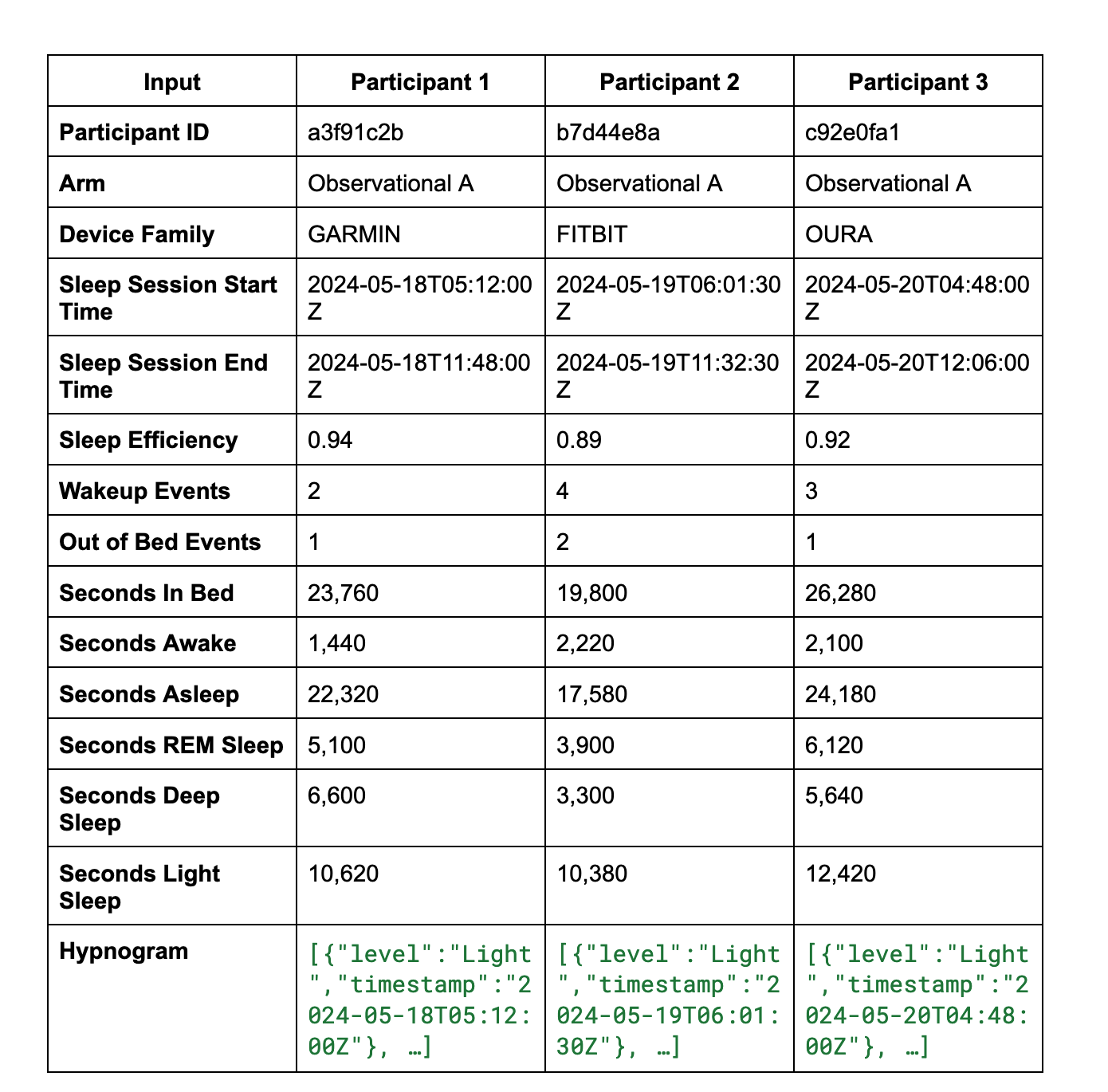
Alethios returns structured, time‑aligned sleep data for each participant, organized by study night rather than calendar day. Data includes:
Example Sleep Data Output (De‑identified)
Two design choices can materially improve the interpretability of wearable sleep metrics, especially when sleep staging is an important analytic component.
First, consider adding a short run‑in period. Consumer wearables often show an initial “settling” period where participants adjust to wearing the device and where algorithms may behave differently as they accumulate baseline patterns. A run‑in reduces the risk that early nights distort baseline estimates or create artificial pre/post differences that are actually acclimation effects.
Second, consider enrolling participants who use the same wearable (or restricting to a single device family for a given analysis). Sleep staging, wake detection, and efficiency are derived from proprietary algorithms that vary meaningfully across providers and device generations. Restricting device heterogeneity reduces measurement variance attributable to differing algorithms, improves comparability across participants, and simplifies interpretation in downstream reporting.
This structure allows for longitudinal analysis of sleep patterns, night‑to‑night variability, and alignment with other study endpoints.
Researchers frequently use wearable‑derived sleep data to:
This post is part of a broader Alethios series on wearable‑derived digital endpoints, including step count, heart rate variability, readiness, temperature, and menstrual cycle tracking.
Buysse DJ. Sleep health: Can we define it? Does it matter? Sleep. 2014.
Walker MP. Why we sleep: Unlocking the power of sleep and dreams. Scribner. 2017.
de Zambotti M, et al. Wearable sleep technology in clinical and research settings. Sleep Medicine Reviews. 2019.
.png)
Whether you're a researcher or participant, Alethios makes health research frictionless and comprehensive.


.svg)