Take the next step
Be part of the future of health research
Whether you're a researcher or participant, Alethios makes health research frictionless and comprehensive.

Resting heart rate (RHR) is one of the most widely used physiological measures in human health research. It reflects autonomic nervous system balance, cardiovascular fitness, recovery status, and overall physiological load. In decentralized and real-world studies, wearable-derived resting heart rate provides a low-burden way to track longitudinal physiological change outside of clinic visits.
Resting heart rate (RHR) is one of the most widely used physiological measures in human health research. It reflects autonomic nervous system balance, cardiovascular fitness, recovery status, and overall physiological load. In decentralized and real-world studies, wearable-derived resting heart rate provides a low-burden way to track longitudinal physiological change outside of clinic visits.
This post explains why resting heart rate is commonly included in research studies, when it is most appropriate, how it is configured in Alethios, and what data researchers receive once a study is live.
Resting heart rate has been studied for decades as a marker of cardiovascular and metabolic health. Across large population cohorts, higher RHR is associated with increased risk of cardiovascular disease and all-cause mortality, even after adjustment for physical activity and other risk factors (Fox et al., 2007; Jensen et al., 2013). While RHR is not diagnostic on its own, it functions as a meaningful physiological signal.
Beyond long-term risk, RHR is sensitive to within-person change. It tends to decrease with improved cardiorespiratory fitness and increase with stress, illness, inflammation, sleep disruption, or accumulated fatigue. For this reason, RHR is often used as a supportive or contextual endpoint, rather than a primary outcome, helping interpret changes in activity, sleep, or symptom measures.
In real-world and decentralized designs, repeated RHR measurements are often more informative than single clinic readings. Trends, variability, and change-from-baseline analyses can capture adaptation or physiological strain that episodic assessments miss.
Resting heart rate is commonly included in studies focused on:
It is less appropriate as a standalone primary endpoint in short-duration studies where physiological adaptation is unlikely, or in populations using medications or with conditions that substantially alter heart rate unless those factors are accounted for analytically.
Alethios supports resting heart rate data from the following personal wearable ecosystems:
Resting heart rate is standardized for use within Alethios. Participants connect their devices during onboarding, after which data is collected passively according to the study schedule.
Different device families derive resting heart rate using proprietary algorithms, typically aggregating heart rate measurements during periods of minimal activity or during sleep. These methodological differences should be considered during study design and analysis.
Configuration takes place during the Build phase of the Study Planner.
Step 1: Navigate to Build → Add Digital Endpoint
From the Build section of your study, select Add Digital Endpoint to configure wearable-derived physiological data collection.
Step 2: Select Digital Endpoints
Within the Digital Endpoints modal, select Resting Heart Rate.
If enabled for your account, you may also select additional endpoints at the same time, such as continuous heart rate, heart rate variability, sleep metrics, or step count. Multiple endpoints can be collected concurrently from the same connected device, depending on provider support and study design.
Step 3: Configure Participant-Facing Copy
You will define participant-facing fields explaining what data is collected and why.
Title
Resting Heart Rate
Description (optional)
Passive tracking of resting heart rate during sleep to assess baseline cardiovascular function and physiological recovery over time.
Justification
Resting heart rate provides an objective indicator of cardiovascular and autonomic function. Tracking changes over time helps researchers understand how an intervention affects physiological stress, fitness, or recovery.
Clear justification improves wearable connection rates and participant understanding.
Step 4: Choose Providers
Select the wearable providers you wish to support. Participants will only see connection options relevant to the providers you enable.
Step 5: Set Requirement Rules
If marked Required, participants must connect a wearable device to become active in the study. If left optional, resting heart rate data will enrich the dataset without gating participation.
Alethios returns structured, time-aligned resting heart rate data organized by study day and derived from the participant’s sleep window. This approach minimizes confounding from movement, caffeine timing, or daytime activity.
Returned fields include:
Example Resting Heart Rate Data Output (De-identified)
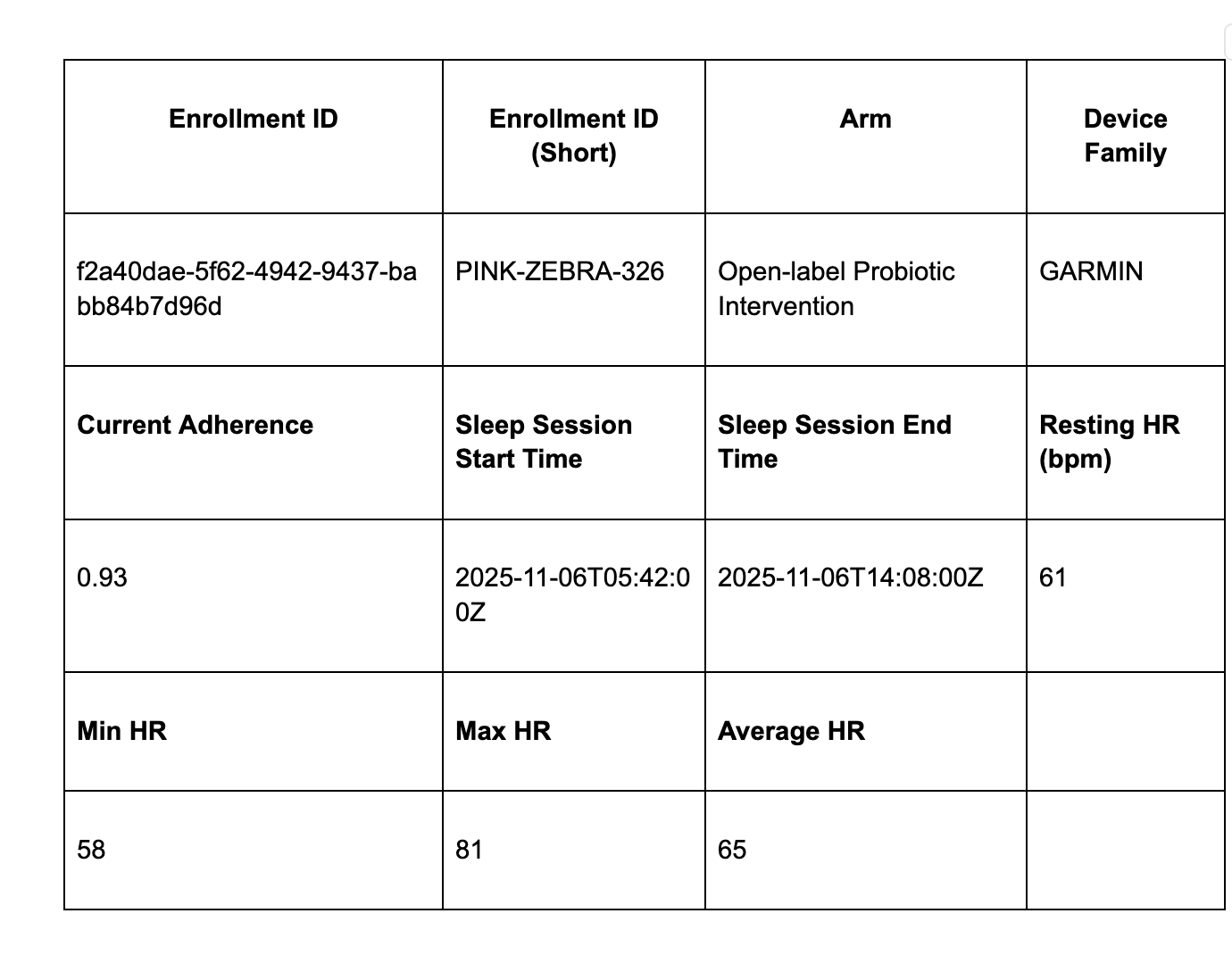
In this structure, resting HR reflects a device-specific estimate of baseline heart rate during the sleep period, while minimum, maximum, and average values provide additional context for nocturnal autonomic activity.
In practice, resting heart rate is rarely interpreted in isolation. Researchers commonly use it to:
The analytic emphasis is typically on change from baseline, trends, or variability rather than absolute thresholds.
Several design choices can materially improve interpretability:
Wearable validation studies consistently show that heart rate accuracy is strongest during rest and sleep conditions, supporting the use of sleep-window-derived RHR in decentralized studies (Bent et al., 2020).
Fox K, et al.
Resting heart rate in cardiovascular disease. Journal of the American College of Cardiology. 2007;50(9):823–830.
Jensen MT, et al.
Elevated resting heart rate is associated with cardiovascular risk and mortality. Heart. 2013;99(12):882–887.
Nanchen D, et al.
Resting heart rate and cardiovascular outcomes. European Heart Journal. 2012;33(12):1470–1478.
Seals DR, et al.
Influence of habitual physical activity on resting heart rate. Journal of Applied Physiology. 2016;120(4):350–357.
Bent B, et al. Investigating sources of inaccuracy in wearable optical heart rate sensors. npj Digital Medicine. 2020;3:18.
.png)
Whether you're a researcher or participant, Alethios makes health research frictionless and comprehensive.


.svg)