Take the next step
Be part of the future of health research
Whether you're a researcher or participant, Alethios makes health research frictionless and comprehensive.

Step count is frequently used as a measure of daily physical activity and functional mobility. Step count should be understood as a functional digital endpoint rather than a standalone clinical outcome. Its strength lies in how it complements other measures, providing objective context for subjective or biological data.
Daily step count is one of the most widely used digital activity measures in human health research. Its value lies in its interpretability, consistency across devices, and low burden for participants. In decentralized and real-world studies, step count provides a practical way to observe changes in functional activity over time without introducing additional tasks or clinic visits.
This post explains why step count is commonly included in health research, when it is appropriate, how it can be configured in a decentralized study using Alethios, and what data researchers receive once a study is live.
Step count is frequently used as a measure of daily physical activity and functional mobility. Across multiple domains, it has been associated with outcomes related to cardiometabolic health, physical function, recovery, fatigue, and mortality (Saint-Maurice et al., 2020; Dwyer et al., 2015). Because it is passively collected, step count can capture real-world behavior that may not be reflected in clinic-based assessments or self-reported outcomes.
In longitudinal studies, step count can reflect both short-term responses to an intervention and longer-term behavioral change, particularly when evaluated relative to baseline or alongside validated questionnaires and other digital endpoints (Tudor-Locke et al., 2011).
Step count should be understood as a functional digital endpoint rather than a standalone clinical outcome. Its strength lies in how it complements other measures, providing objective context for subjective or biological data.
Step count is commonly used in studies focused on:
It is less appropriate as a primary endpoint in very short interventions or in populations where step-based activity is not a meaningful representation of daily function, unless stratification and context are explicitly addressed.
Alethios supports daily step count collection from the following personal wearable ecosystems:
Step count is universally available across supported providers and standardized for use within Alethios. Participants connect their devices during onboarding, after which data collection occurs passively according to the study schedule.
Configuration takes place during the Build phase of the Study Planner.
Step 1: Navigate to Build → Add Digital Endpoint
From the Build section of your study, select Add Digital Endpoint to begin configuring wearable-derived data collection.
Step 2: Select Digital Endpoints
Within the Digital Endpoints modal, select Daily Step Count.
If enabled for your account, you may also select additional wearable-derived endpoints at the same time, such as heart rate, continuous heart rate, heart rate variability, floors climbed, readiness or recovery scores, and sleep metrics. Multiple endpoints can be collected concurrently from the same connected device, depending on provider support and study design.
Step 3: Configure Participant-Facing Copy
You will be prompted to define participant-facing fields that explain what data is collected and why.
Title
Wearable-Derived Activity and Recovery Metrics
Description (optional)
Continuous monitoring of daily activity levels, mobility patterns, and physiological recovery metrics to assess functional improvements in real-world settings. Data collected includes step count, floors climbed, heart rate variability recovery time, and sleep quality metrics.
Justification
Wearable data provides objective, continuous tracking of functional outcomes in everyday settings, enabling detection of subtle improvements in mobility and physical activity. This complements subjective pain assessments and helps quantify real-world treatment benefits over time.
Clear justification materially improves wearable connection rates. Participants are more likely to connect a device when they understand the relevance of the data and how it will be used within the study.
Step 4: Choose Providers
Select which wearable providers you wish to support. Participants will see only the connection options relevant to the providers you enable.
Step 5: Set Requirement Rules
If the endpoint is marked Required, participants must connect a wearable device in order to become active in the study. If left optional, wearable data will enrich the dataset without gating participation.
Alethios returns structured, time-aligned step count data for each participant, organized by study day rather than calendar day. Data includes enrollment ID, study arm, device family, study day start and end timestamps, midday and end-of-day step counts, distance traveled (meters) when supported, and adherence metrics based on data availability.
Example data output
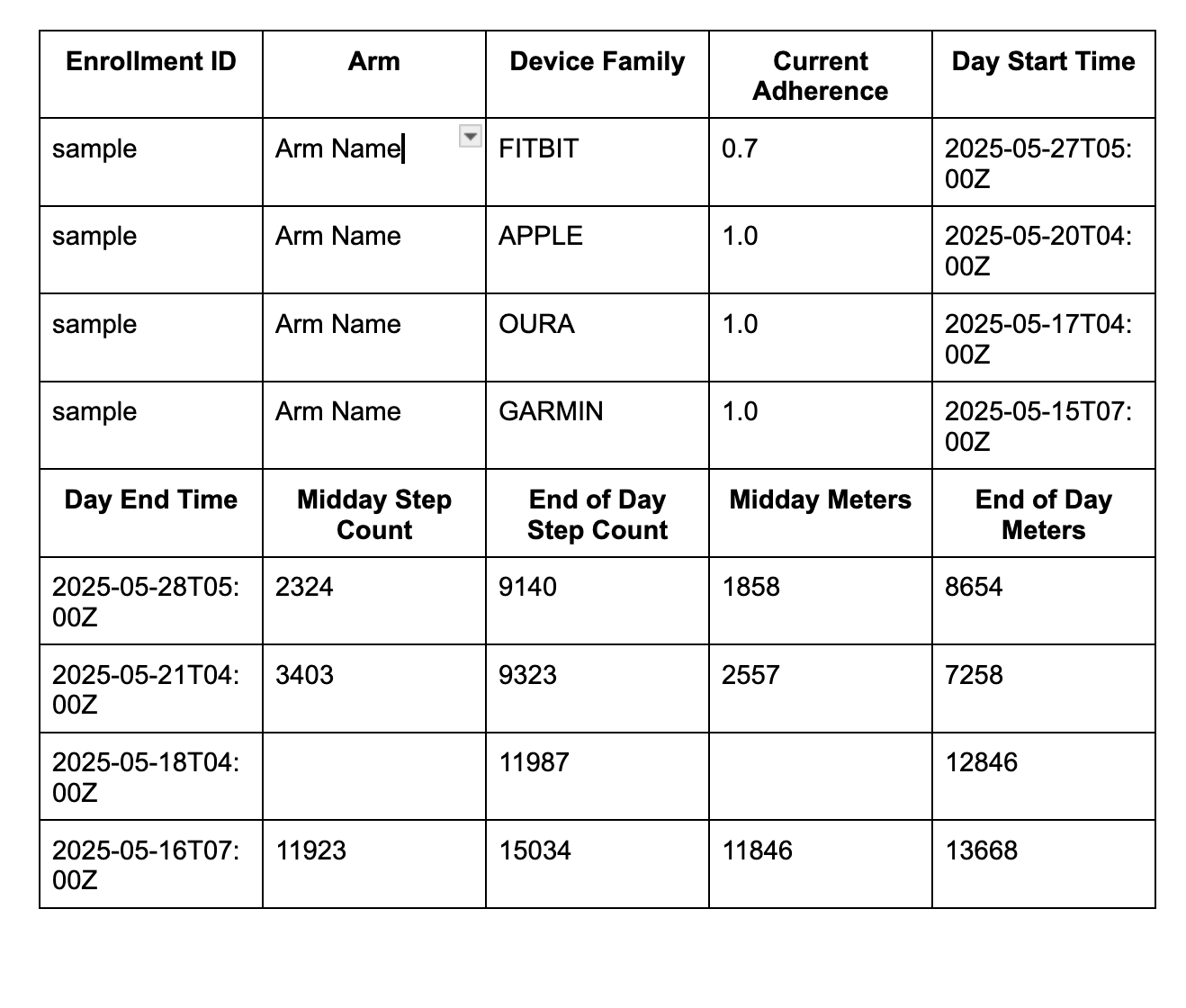
This structure allows for longitudinal analysis, arm-level comparisons, and alignment with other study endpoints.
Researchers frequently use step count data to:
This post is part of a broader Alethios series on wearable-derived digital endpoints, including sleep, heart rate variability, readiness, temperature, and menstrual cycle tracking.
Saint-Maurice PF, Troiano RP, Bassett DR Jr, et al. Association of daily step count and step intensity with mortality among US adults. JAMA. 2020.
Dwyer T, Ponsonby AL, Ukoumunne OC, et al. Association of change in daily step count over five years with all-cause mortality. BMJ. 2015.
Tudor-Locke C, Craig CL, Brown WJ, et al. How many steps/day are enough? For adults. International Journal of Behavioral Nutrition and Physical Activity. 2011.
.png)
Whether you're a researcher or participant, Alethios makes health research frictionless and comprehensive.


.svg)