Take the next step
Be part of the future of health research
Whether you're a researcher or participant, Alethios makes health research frictionless and comprehensive.

Learn how Alethios makes it easy to add validated, at-home body composition tracking — smartphone imaging, smart scales, and continuous data collection — to your next decentralized clinical trial.
This is the final post in our three-part series on body composition. Part one made the case for why body composition tells you more than weight or BMI ever could on their own. Part two walked through how it's actually measured, from DEXA and hydrostatic weighing to smartphone imaging and smart scales. This post shows exactly how to put that measurement to work inside your own study.
As covered in parts one and two of Alethios' Body Composition blog series, weight and BMI can't tell two people apart who lose the same amount of weight but end up in very different metabolic shape—and closing that gap has historically meant trading accuracy for accessibility, or the other way around. Alethios is built to close it without making you choose.
Alethios supports several ways to incorporate body composition measurement into your study, without asking a single participant to drive to a clinic.
Alethios integrates with Prism Labs to bring body composition imaging on a smartphone to decentralized trials. Participants record a short video on their phone from home and the results go straight into the Alethios platform. 3D reconstruction from video approaches—like Prism Labs' mobile body scanning technology—can estimate where fat and lean mass are actually distributed across the body, not just a single overall number. In Prism Labs' published validation against DXA (n=273, drawn from a dataset of over 3,700 scans), body fat percentage came in within about 3.2 percentage points on average (r=0.95), with even tighter agreement on visceral fat and appendicular lean mass—accuracy that held up even among participants with a BMI of 30 or higher, according to Prism Labs' 2026 white paper.
When building your study in Study Planner, navigate to II. Data Collection > Digital Biomarkers.

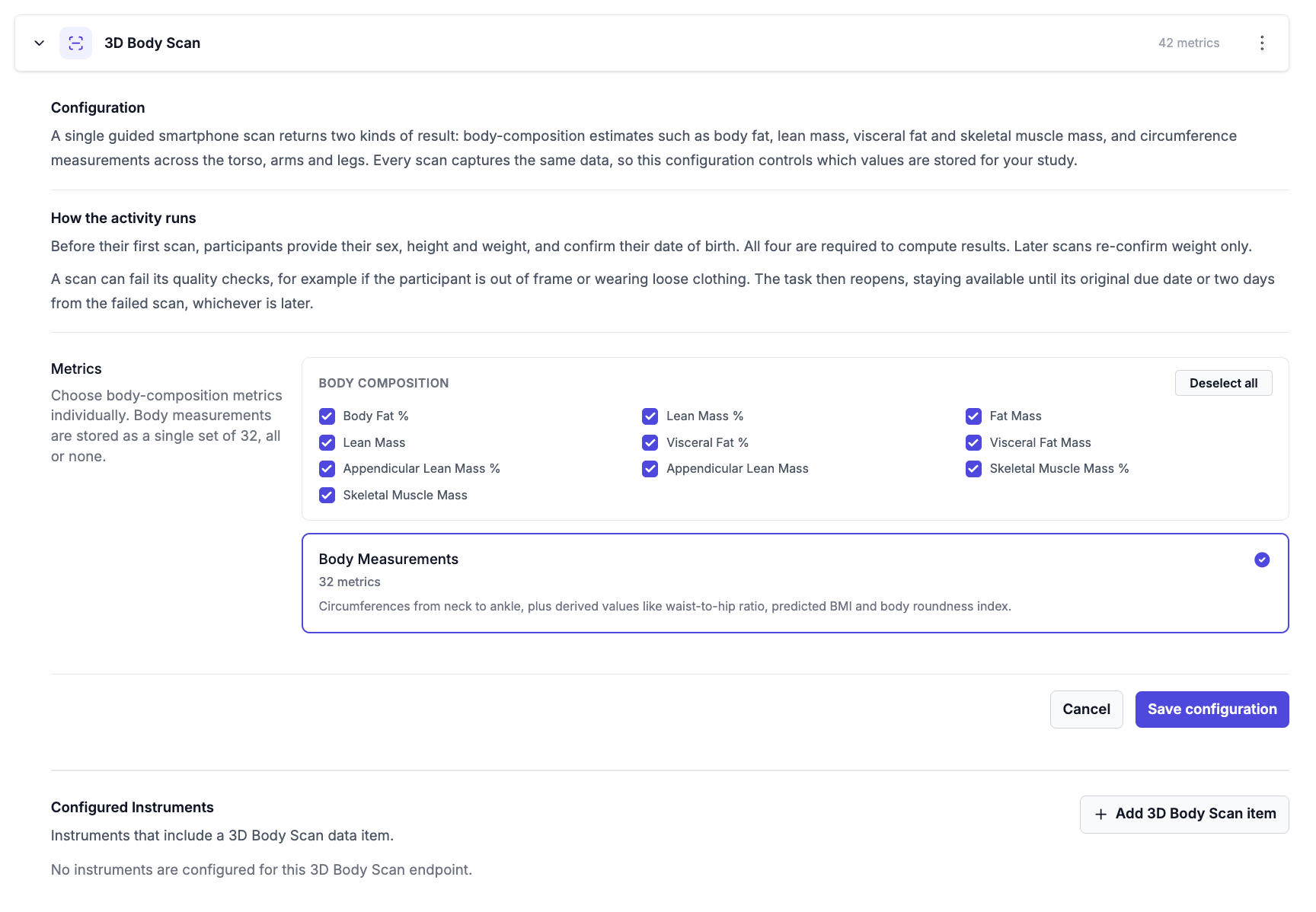

The 3D Body Scan is fully integrated into the Alethios platform, so it seamlessly fits into the other study tasks.
Smart scales and at-home bioelectrical impedance devices can be shipped directly to participants, syncing weight, fat mass, and lean mass data automatically as part of your study's data pipeline—no manual entry, no clinic visit. Alethios integrates directly with smart scales from Withings and Garmin and bioelectrical impedance analyzers from InBody, so a study can pick the device that fits its budget and its accuracy needs without building a separate data pipeline for each one.


Not every study needs dedicated hardware to get a useful body composition signal. For teams working with tighter budgets, or participants who'd rather not use a scale or scan, Alethios can combine simpler inputs—a couple of progress photos, a weight measurement from a scale the participant already owns, and waist, hip, or limb circumference from a measuring tape—into a lower-cost estimate of change over time. It won't match the precision of a 3D scan or a BIA device on any single day, but tracked consistently, it still gives studies that can't equip every participant with new hardware a meaningful read on whether an intervention is shifting fat and lean mass.
Alethios is built to collect participant data without anyone driving to a trial site, which means participants can contribute data at many points across a study instead of just one or two check-ins. That shift—from a handful of clinic visits to easy, at-home collection—changes what a study can actually see: instead of two snapshots, researchers get a trajectory. A device doesn't need to nail someone's exact body fat percentage on day one if it can reliably detect how that number moves by day ninety.
Because Alethios integrates multimodal data collection, that trajectory doesn't have to stop at body composition. Wearables can capture a participant's activity level and the type of exercise they're doing alongside it. Validated questionnaires can capture how someone feels, not just what their body shows. At-home biomarker testing or a continuous glucose monitor can show how body composition changes track with metabolic health or inflammation. Combining these data types—especially the ones collected continuously—builds a bigger, stronger picture of how the body is changing than a clinic visit or two ever could.
Body composition measurement through Alethios is especially valuable for GLP-1 and other weight-management trials, where regulators and researchers increasingly expect lean-mass data alongside weight, supplement and nutrition research whether a product protects muscle rather than just reducing the number on the scale, exercise science studies making muscle-building or fat-loss claims, bariatric and surgical weight-loss research tracking lean-mass cost after a procedure, and longevity and aging research treating lean mass as a biomarker in its own right.
Curious what body composition data could add to your next study? Book a demo.

Whether you're a researcher or participant, Alethios makes health research frictionless and comprehensive.


